If you're over 60, balance probably isn't something you think much about — until the day you start noticing it.
Maybe you feel a little less steady walking on uneven ground.
Maybe getting dressed while standing up feels less automatic than it used to.
Maybe you've had a fall, a close call, or one of those moments where you caught yourself and thought, That could have gone badly.
If so, you're not imagining it.
Balance often changes as we get older. And while most people understand that falling is something they want to avoid, far fewer realize how important balance training can be in helping them stay active, confident, and independent.
That's what I want to talk about here.
Because balance training is not just for athletes, yoga classes, or people standing on one foot in a gym. For adults 60+, it's one of the most practical things you can do to protect your mobility, your confidence, and your ability to keep living life on your own terms.
Balance problems are about more than falling
When most people hear the word balance, they think of one thing: falling.
And yes — that matters. A lot.
A fall at 25 is one thing. A fall at 65, 75, or 85 can be something else entirely. It can mean a broken bone, a hospital stay, a loss of confidence, a long recovery, or a fear of moving that lingers long after the bruises are gone.
But balance problems affect more than whether you fall.
They can also affect:
- how confident you feel walking outdoors
- whether you trust yourself on stairs
- how steady you feel getting out of a chair
- whether you avoid certain activities because you don't feel stable
- how much freedom you still feel you have in your own body
That's why balance training deserves far more attention than it usually gets.
Because this isn't just about preventing accidents. It's about preserving independence.
Why balance tends to change with age
There are a lot of reasons balance can become more of an issue as we get older.
Sometimes it's simply because we've become less active, and the muscles that help us stay upright, stable, and coordinated aren't as strong or responsive as they used to be.
Sometimes it's tied to joint pain, stiffness, reduced mobility, vision changes, medication side effects, or changes in the feet and ankles.
Sometimes it's the result of chronic health conditions, inactivity, or just years of moving less because the body doesn't feel as trustworthy as it once did.
And often, it's a combination of several things.
That's one of the reasons I encourage adults 60+ not to brush balance concerns aside as "just aging." Yes, changes happen as we get older. But that doesn't mean you're powerless, and it doesn't mean there's nothing you can do to improve the situation.
In many cases, balance can absolutely be trained, supported, and improved.
Why balance training is personal for me
This is not just something I coach. It's something I take seriously in my own life.
At age 60, I was diagnosed with Fat Pad Atrophy, which means the natural cushioning on the bottom of my feet has thinned and become uneven. That may not sound like much to someone who's never dealt with it, but it affects how I stand, how I walk, and how steady I feel on my feet.
For most people, falling is already a serious concern as they get older.
For me, having Fat Pad Atrophy made balance an even bigger issue.
It made me more aware of uneven surfaces. More aware of the way a small misstep can turn into a problem. More aware that walking indoors or outdoors without paying attention is not something I can take for granted.
And it also made one thing very clear to me:
Even if I never have perfect balance, balance training is still one of the most important things I can do for myself.
That's an important point, because I think a lot of people assume balance training only matters if it can "fix" everything.
That's not the goal.
The goal is not perfection. The goal is improvement.
The goal is becoming steadier than you are now. More aware than you are now. More capable of catching yourself, moving confidently, and navigating daily life with less fear than you have now.
I can say honestly that balance training has become one of the most important parts of how I take care of myself. Without it, I'm sure I would have had more falls and more close calls over the years than I already have.
That's one of the reasons I care so much about helping other adults 60+ take it seriously too.
The hidden cost of poor balance: fear
One of the biggest problems with declining balance isn't always the physical side of it.
Sometimes it's the fear.
Fear of falling has a way of quietly shrinking a person's life.
You stop walking as much because you don't trust uneven sidewalks.
You avoid stairs when you can.
You get more cautious carrying things.
You stop going certain places.
You sit more.
You move less.
You get weaker.
And that weakness can make your balance even worse.
It becomes a cycle.
This is one of the reasons I care so much about helping people build confidence along with strength and balance. Because the goal isn't just to improve how your body performs during an exercise.
The goal is to help you trust your body more in real life.
Balance training is really independence training
When I work with adults 60+, I'm not interested in balance for the sake of balance.
I'm interested in what better balance helps you do.
Can you get out of a chair more confidently?
Can you walk through your house without feeling unsteady?
Can you go outside and feel safer on the driveway, sidewalk, or lawn?
Can you recover more effectively if you trip?
Can you move with less fear and more confidence?
That's the real point.
Balance training supports the kind of daily life most people want to keep living:
- staying in their own home
- walking with confidence
- doing errands without fear
- carrying groceries
- navigating stairs
- staying active with children and grandchildren
- reducing the chance that one bad fall changes everything
That's why I look at balance work as independence training.
What balance training actually looks like
A lot of people hear "balance training" and picture something awkward, extreme, or unsafe.
That's not what I mean.
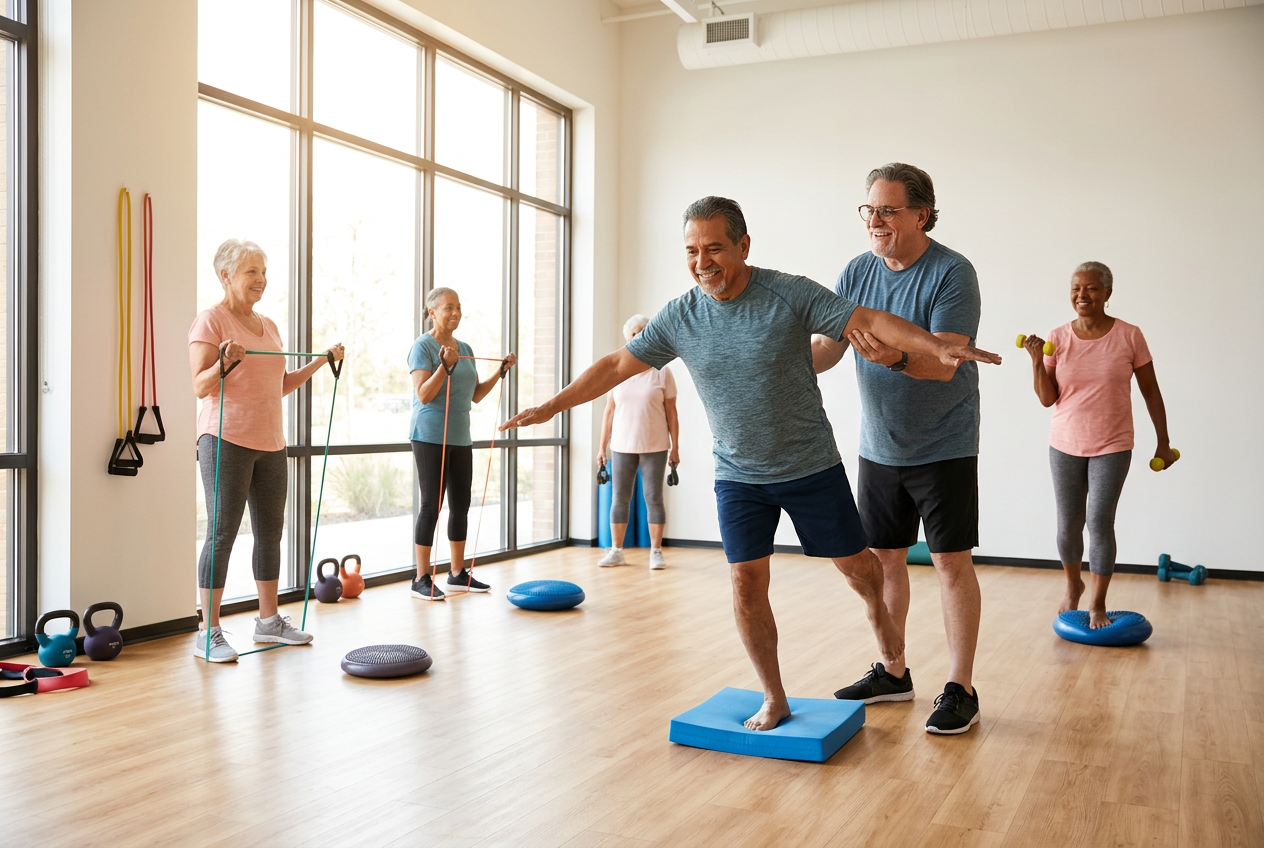
Balance training can be very simple, very practical, and very appropriate for the person in front of me.
Depending on someone's current ability, balance work might include things like:
- improving leg and hip strength
- practicing standing with better posture and control
- building ankle stability
- working on shifting weight safely from side to side
- practicing supported single-leg balance
- improving how confidently someone can step, turn, and recover their footing
- combining strength and balance exercises in ways that relate directly to daily life
The key is that it has to be appropriate for your body, your health history, and your current level of confidence.
Balance training should challenge you enough to create improvement, but not so much that it makes you feel unsafe or discouraged.
Strength and balance go together
This is another piece people often miss.
If your legs are weak, balance gets harder.
If your hips are weak, balance gets harder.
If your core is weak, balance gets harder.
That's one reason balance training should never live in a separate box from strength training. The two support each other.
When you improve the muscles that help you stand, walk, climb stairs, get out of a chair, and recover from a stumble, you're also helping support better balance.
That's why the work I do with adults 60+ is never just about one thing. It's about helping the body become more capable as a whole — stronger, steadier, and more confident.
Three safe ways to start working on balance
If balance has become a concern for you, that does not mean you should start doing anything reckless in the name of "training." Safety comes first.
But there are simple ways to begin.
1. Practice sit-to-stands
One of the best places to start is simply practicing standing up from a chair and sitting back down with control.
This builds leg strength, improves coordination, and supports one of the most important real-life movements there is: getting up safely.
2. Work on supported single-leg balance
Stand near a kitchen counter, sturdy chair, or wall for support and practice briefly lifting one foot off the ground while staying tall and steady.
You don't need to hold it for long. The point is to gently challenge your balance in a safe environment.
3. Build strength in the muscles that support balance
Balance isn't just about "balance drills." It's also about strengthening the body parts that help you stay upright and recover when you lose your footing.
That includes your legs, hips, glutes, and core.
Even simple strength work can make a meaningful difference over time.
Important note: If you already feel very unsteady, have fallen recently, or have medical issues that affect your balance, it's smart to work with a qualified professional rather than trying to figure it out on your own.
If your balance doesn't feel the way it used to, don't ignore it
A lot of people wait until they've already had a fall to take balance seriously.
I'd rather see people address it sooner.
If you've noticed that you feel less steady than you used to, that doesn't mean you should panic. But it does mean it's worth paying attention.
It's worth asking yourself:
- Do I trust my footing the way I used to?
- Have I become more cautious because I'm afraid of falling?
- Do I feel unstable on stairs, uneven ground, or when I move too quickly?
- Have I stopped doing certain things because I don't feel steady?
- Am I getting weaker, more sedentary, or less confident in my body?
Those are not small questions.
They're questions about quality of life.
It is not too late to improve
One of the biggest myths people carry into their 60s, 70s, and beyond is the idea that if balance has gotten worse, there's not much they can do about it.
I don't believe that for a second.
I believe a lot can improve when the right things are trained consistently and safely.
Will every person have perfect balance? No.
I won't. You may not either.
But better balance is not the same thing as perfect balance.
If you can become steadier than you are now...
If you can feel more confident walking...
If you can reduce your fear of falling...
If you can improve your ability to move through daily life safely...
that matters.
And it can make a real difference in how long you stay active, capable, and independent.
Final thoughts
If I could convince more adults 60+ to focus on one thing beyond just "getting exercise," it would be this:
Don't overlook your balance.
Balance affects more than whether you fall. It affects how you move, how you feel, what you avoid, and how much confidence you have in your own body.
For me, balance training is personal. With Fat Pad Atrophy, I know I have to pay attention to it. I know I have to work at it. And I know how much it matters.
For you, the details may be different. But the principle is the same.
If you want to stay strong, steady, and independent for as long as possible, balance deserves a place in the plan.
Because at this stage of life, the goal isn't perfect balance.
The goal is protecting your ability to keep living life on your own terms.
If balance has become a concern for you, or you simply want to feel steadier and more confident on your feet, I'd be honored to help. Book a free call and let's talk about where you are now and what kind of support would help most.